
Birds, Books and a Hidden Mouse: Eliza Moulder’s Art Takes to the Trail
Tuesday, November 24th, 2026
Illustration Student Eliza Moulder’s Little Free Library Invites Lancaster to Slow Down, Look Closely and Read
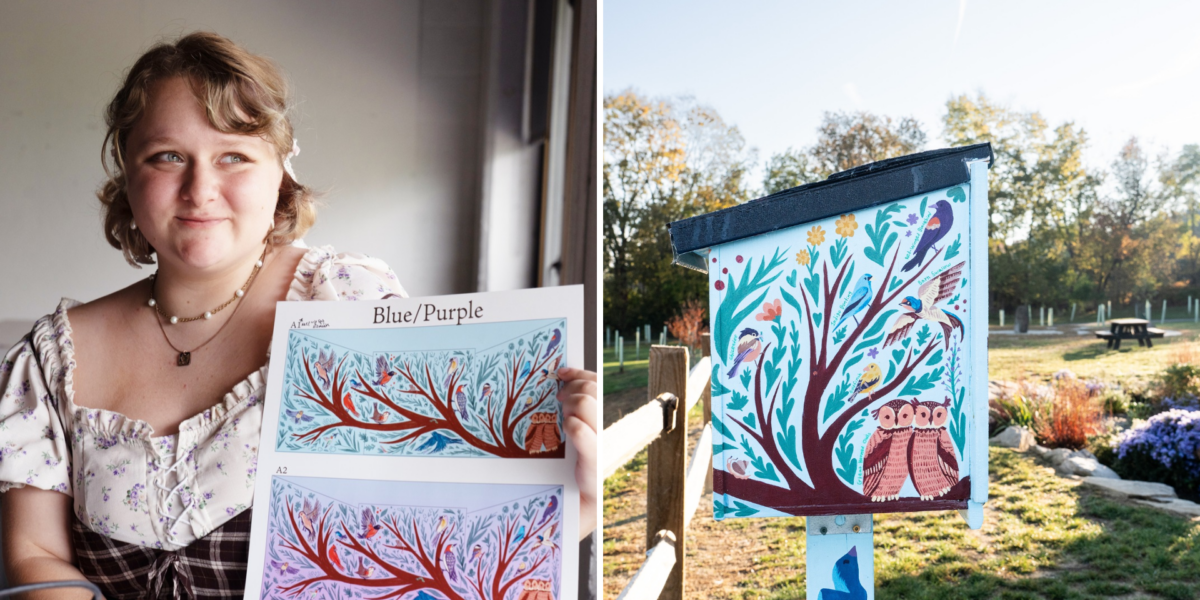
Along the Little Conestoga Creek at Noel Dorwart Park, a new Little Free Library offers walkers a book to borrow and a reason to slow down. Its painted panels are filled with the native birds that live along the creek. Look a little longer and you’ll find a mouse and a few bugs hiding in the vines.
The design belongs to Eliza Moulder, an illustration senior at PCA&D. She created it through a paid summer internship with the Blue Green Connector’s Art on the Trail program. Led by the Steinman Foundation, the Blue Green Connector is restoring the Little Conestoga Creek and building a 3.5-mile accessible greenway that brings together clean water, recreation, education and art.
Moulder carried the project from first sketch to final art. She presented design options to her client, wrote a proposal, negotiated her fee and created a set of companion pieces visitors can take home for free: a bird zine, a bird-search activity sheet, stickers and bookmarks. The library itself was built by Josh Beck of Boy Scout Troop 349 as his Eagle Scout project.
We asked Moulder about the project, what it taught her about working as an illustrator and why she plans to build her career in Lancaster.
How did you get involved with Art on the Trail?
I was working with Natalie Lascek at PCA&D’s Center for Creative Exploration and looking for a summer internship when she told me about the Blue Green Connector opportunity. They needed an illustrator to design a Little Free Library at the Noel Dorwart Park trailhead, and the theme was local birds. I was in right away. My work leans toward florals, birds, bugs and fruit, partly because I’m really into surface design.
I met with Emily Landis, the Steinman Foundation’s director of education & environmental strategy, at the park, learned about the project and shared my portfolio. After a few more meetings where I presented sketches and different design options, they chose the one I liked best.
Where did the design come from?
I love patterns, florals and decorative elements, and I’m a big fan of William Morris. I wanted to bring some of that filigree feeling into the design while keeping it simple enough to read on a box outdoors.
I also wanted it to be interactive, almost like a look-and-find for kids. There’s a mouse and a few bugs hidden in the design, so children have a reason to look closely and get curious.
What else did you create?
A bird zine, a bird-search activity sheet, stickers and bookmarks. The search sheet features the same birds that appear on the library, so kids can take it on a walk and try to spot them in real life. The bookmarks bring it back to reading, and the zine let me revisit an idea I’d first sketched for a class. I wanted everything to feel like one connected set.
How did PCA&D prepare you to run a project from start to finish?
Honestly, every assignment prepared me for this. Our assignments feel like jobs. We develop concepts, make sketches and mock-ups, get feedback and decide what moves forward. That gave me confidence presenting my work and offering the client options that were meaningfully different.
I also learned how to work with a client. Sometimes you have an idea you love, but you need to understand what the client wants, too. Illustration is about giving people what they ask for while offering alternatives you think might work better.
Who helped you along the way?
I had a lot of people in my corner. Natalie helped with paperwork, my proposal and asking to be paid. Robert Young, chair of illustration, helped me navigate that side, too.
Matt Chapman, a PCA&D alum and adjunct instructor, was a huge supporter. He gave me advice on materials, and I’d stop by curio, the downtown gallery and creative supply shop, to show him my sketches. If I left a meeting feeling unsure, he gave me honest feedback and helped me see that the work was strong. Illustration faculty Liz Pulido and Daniel Fishel have been important influences as well. The faculty taught me to trust my abilities, not only how to make art. I could make real decisions on a real project and still know I had people to turn to.
Finally, my friend and fellow PCA&D student, Gillian Short, was instrumental in making this project come to life. She took time out of her schedule this summer to teach me how to sketch with virtual reality and assisted me with sanding and prepping the surfaces of the library. She generously shared all of her skills as a mural artist and I cannot thank her enough.
What did you learn about the business side of illustration?
How to write a proposal and how to ask to be paid. As artists, we can get so excited about a project that we forget our work has value. I had to get comfortable talking about what I should earn.
I also learned how much illustration depends on communication. You listen to the client, understand what they need and present ideas that help them make decisions.
What do you hope visitors take away?
I hope it encourages people to look up and notice the world around them. You don’t need to be a serious birdwatcher with special equipment to enjoy birds. You can just go for a walk and see what you notice.
I especially wanted kids to feel curious. If you see a beautiful illustration of a bird along a trail, it might make you stop, look closer and want to learn more. And it’s all connected: plants support bugs, and bugs support birds. Taking care of one part of nature means paying attention to all of it.
How has Lancaster shaped you as an artist?
I’m from New Jersey. When I visited PCA&D, it felt right. It was homey and comfortable, not overwhelming, and I loved walking around Lancaster. Now it’s my favorite place. There’s such a good art community here, with galleries, art markets, illustrators and artists who support each other. You start recognizing people and feeling connected.
Lancaster is down-to-earth. You can show your work, meet other artists and find opportunities without having to fit a certain mold. I plan to stay after graduation and build a career in freelance illustration and community-based projects.
What would you tell someone considering PCA&D?
That it’s a safe space, and the teachers make a real difference. I struggled in school before I came here and didn’t always feel confident in my abilities. Once I was learning something I really cared about, things started to click. I became a much more confident student and had opportunities I never would have imagined.
The faculty support you, but they also expect you to do the work, make decisions and figure things out for yourself. Add a creative community where people want to see each other succeed, and it’s meant a lot to me.
My long-term dream is to work as a freelance illustrator for a few years and then come back to teach illustration at PCA&D. It’s such a great place to learn, in the best part of the city.
Visit the library: Find Eliza’s Little Free Library at Noel Dorwart Park along the Blue Green Connector. Take a book, leave a book and pick up a free bird zine and bird-search activity sheet for your walk. Art on the Trail is part of the Blue Green Connector, led by the Steinman Foundation.
See more of Eliza’s work at elizamoulder.com.
Thinking about illustration? Explore PCA&D’s Illustration program and plan a visit.
Collaborate with PCA&D: If your business or organization is interested in partnering with PCA&D’s Center for Creative Exploration, please contact Executive Director Natalie Lascek at ce@pcad.edu.